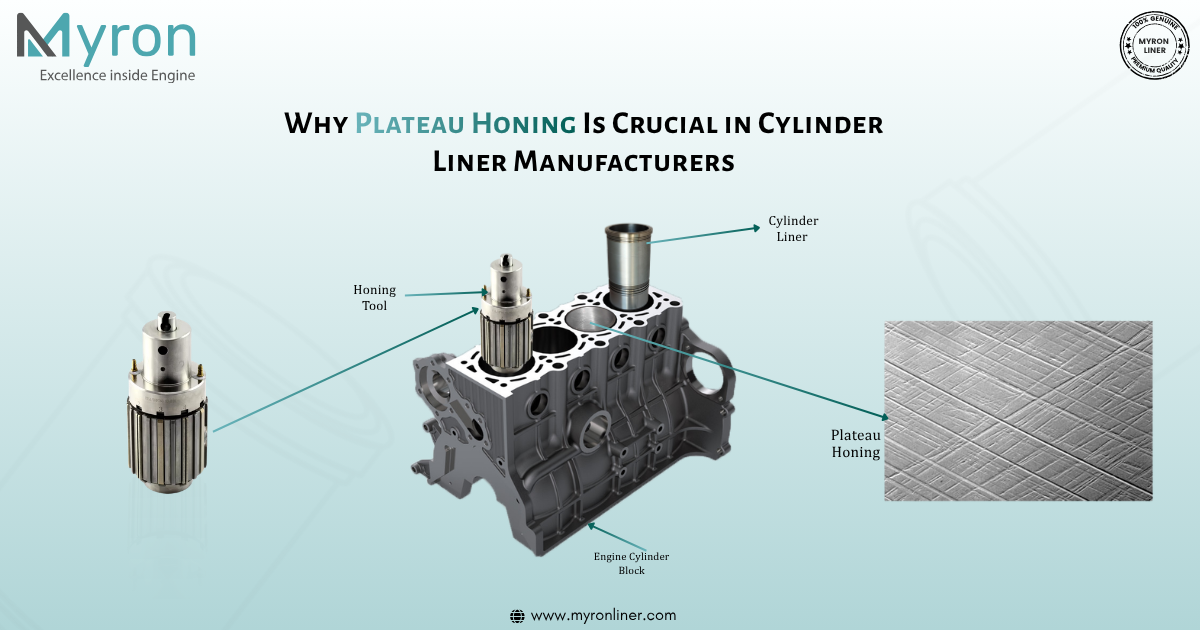
Why Plateau Honing Is Crucial in Cylinder Liner Manufacturers
In the world of internal combustion engines, engine performance depends heavily on the precision and quality of its components. One of the most critical yet often overlooked parts is the cylinder liner. For manufacturers, ensuring that cylinder liners meet durability, efficiency, and performance standards involves more than just casting and shaping. One specialized technique that has become indispensable in recent years is plateau honing.
This advanced honing process not only improves the finish of the liner's surface but also significantly enhances lubrication, reduces wear, and ensures consistent engine performance. In this blog, we will explore what plateau honing is, how it works, and why cylinder liner manufacturers are prioritizing this technique to meet modern engine demands.
Understanding Cylinder Liners and Their Importance
A cylinder liner, also known as a cylinder sleeve, is a replaceable metal tube inserted into an engine block to form the inner wall of a combustion chamber. Its primary role is to provide a hard-wearing surface for piston movement, maintain compression, and manage heat distribution within the engine.
Over time, cylinder liners are subjected to immense pressure, temperature fluctuations, and continuous friction. Without proper surface finishing, these liners can wear prematurely, causing oil consumption, reduced compression, and, ultimately, a decline in engine performance.
That's where honing – and more specifically, plateau honing – becomes essential.
What Is the Honing Process?
The honing process is a machining technique that improves the surface finish and dimensional accuracy of metal parts. In the case of cylinder liners, honing creates fine crosshatch patterns on the inner surface, which are essential for retaining oil and facilitating smooth piston movement.
Standard honing typically leaves behind sharp peaks and deep valleys in the metal surface. While this may be sufficient for basic applications, high-performance, and long-lasting engines demand more refined solutions.
What Is Plateau Honing?
Plateau honing is an advanced form of honing that removes the sharp peaks left behind by conventional honing while retaining the valleys. This results in a plateau-like surface that is smoother and better suited for oil retention.
The process generally involves two stages:
- Rough honing – to create the initial crosshatch pattern.
- Finish honing – to remove the surface peaks and achieve a flat-topped "plateau" surface.
The valleys help with oil retention and lubrication, while the smooth plateaus reduce friction and wear during piston movement.
Read More: Understanding How Engine Piston Rings Work
Why Cylinder Liner Manufacturers Use Plateau Honing
Leading cylinder liner manufacturers incorporate plateau honing into their production for several compelling reasons. This advanced surface finishing method offers both mechanical and operational advantages that are critical to engine longevity, fuel efficiency, and overall performance.
1. Improved Lubrication Retention
Plateau honing leaves behind microscopic valleys that act as reservoirs for lubricating oil. These valleys help maintain a consistent film of oil between the piston rings and the cylinder liner, reducing friction and preventing metal-to-metal contact.
The smoother plateaued surface reduces oil consumption, as sharp peaks do not excessively scrape away oil. As a result, the engine operates more quietly, generates less heat, and runs more efficiently over extended periods. This is particularly beneficial in engines that run at high RPM or under continuous heavy loads.
Read More: How Cylinder Liner Thickness Impacts Engine Efficiency
2. Reduced Break-In Time
Engines with conventionally honed liners typically require a longer break-in period to wear down the peaks and establish optimal oil film coverage. Plateau-honed liners, however, are nearly "broken in" right from the start, allowing engines to perform at optimal levels sooner.
For cylinder liner manufacturers serving the aftermarket sector, this is a key advantage. It enables engine rebuilders, mechanics, and performance enthusiasts to achieve faster results and improved efficiency without extended downtime.
3. Minimized Wear and Tear
Excessively rough surfaces cause increased wear on piston rings, leading to blow-by, oil consumption, and reduced engine life. Plateau honing eliminates surface irregularities that accelerate this wear, resulting in longer-lasting engine components. This benefit is especially crucial in high-load applications like trucks, marine engines, and industrial equipment.
This reduction in mechanical abrasion extends the life of both the piston rings and the cylinder liner, cutting down on maintenance costs and improving the overall lifecycle of the engine. It also helps maintain compression consistency, which is essential for fuel efficiency and power delivery in both gasoline and diesel engines.
4. Improved Emissions and Fuel Economy
As global emissions regulations tighten, engine performance and efficiency become top priorities. Plateau honing helps achieve better combustion chamber sealing, which in turn reduces emissions and improves fuel economy. Cylinder liner manufacturers who adopt plateau honing align their products with the evolving environmental standards.
With better ring-to-wall sealing, unburnt fuel and oil bypass are minimized, resulting in cleaner exhaust gases. This makes it easier for rebuilt engines to meet regulatory standards, making plateau honing a valuable process for cylinder liner manufacturers catering to eco-conscious markets.
5. Enhanced Heat Transfer
Proper surface finishing ensures better contact between the liner and the engine block, which is essential for heat dissipation. Plateau honing improves the contact area, allowing for more efficient thermal conductivity and engine cooling.
A well-honed surface prevents hot spots that could lead to thermal expansion issues, scoring, or warping of the liner. Improved heat management contributes to engine stability under high load or high-speed conditions, increasing the reliability of the entire engine system.
6. Consistent Surface Geometry for Better Piston Movement
One often overlooked benefit of plateau honing is the creation of a uniform bore geometry. This consistency ensures that piston rings maintain a proper seal while minimizing resistance during movement.
It reduces ring flutter and stabilizes piston motion, particularly at high RPMs or during cold starts. This not only enhances the engine performance but also contributes to lower noise levels, smoother acceleration, and reduced mechanical stress on engine parts.
Industries That Rely on Plateau-Honed Cylinder Liners
Automotive Industry – From cars to performance sports vehicles, plateau honing ensures smooth engine operation.
2. Heavy-Duty Machinery – Construction and mining equipment benefit from longer engine life.
3. Marine Engines – With engines running for prolonged periods, the need for efficient lubrication is vital.
4. Generators and Stationary Engines – Reliability and durability are non-negotiable in these setups.
No matter the application, plateau honing plays a direct role in maintaining engine performance and operational reliability.
Quality Control in Plateau Honing
Top cylinder liner manufacturers adhere to stringent quality control processes during the honing stage. These include:
- Surface roughness measurements using profilometers.
- Crosshatch angle checks to ensure consistent oil spread.
- Microscopic inspection for defect detection.
- Dimensional accuracy verification to maintain piston-to-liner clearance.
The precision required in plateau honing demands experienced operators and cutting-edge machinery, making it a benchmark of manufacturing excellence.
Future of Plateau Honing in Manufacturing
With the growing push towards cleaner, more efficient engines, the demand for advanced surface finishing processes like plateau honing is set to rise. Automation, AI-assisted quality control, and smart manufacturing are already being integrated into the honing process to improve consistency and scalability.
Moreover, innovations in honing abrasives and machines are enabling even tighter tolerances and more controlled finishes. This ensures that cylinder liner manufacturers stay ahead in the race for performance and compliance.
Choosing the Right Cylinder Liner Supplier Matters
If you're a parts reseller, distributor, or engine builder or involved in engine reconditioning, working with a reliable supplier is critical. You need a partner who understands not just the casting of liners but the surface finishing processes that truly impact engine performance.
This is where Myron Liners excels.
Myron Liners – Precision Cylinder Liner Manufacturers You Can Trust
Myron Liners is a trusted name in the industry, offering a wide range of high-quality cylinder liner solutions for diesel engines, automotive applications, and industrial machinery. What sets them apart is their commitment to excellence at every stage of production – especially in the honing process.
By incorporating plateau honing techniques, Myron Liners delivers products that ensure superior wear resistance, oil retention, and long service life. Whether you're looking for custom-engineered liners or bulk manufacturing for aftermarket supply, Myron Liners brings unmatched precision and reliability to the table.
Final Thoughts
In today's competitive engine manufacturing landscape, every detail counts. From casting materials to surface finish, the quality of a cylinder liner can make or break an engine's performance. That's why plateau honing is no longer just an option - it's a necessity.
For cylinder liner manufacturers, adopting the honing process ensures that their products meet the highest standards of efficiency, durability, and compliance. For end users, it means engines that last longer, run smoother, and perform better.
Choose wisely. Choose quality. Choose Myron Liners.
Explore their full range of cylinder liner offerings at https://www.myronliner.com/ and experience the difference that expert craftsmanship makes.
Reference:
Honing (metalworking) by Wikipedia[1].
FAQ
1. What is the difference between honing and plateau honing?
Honing is a machining process that uses abrasive stones to create a crosshatch pattern inside components like cylinder liners, improving surface finish and dimensional accuracy. However, it typically leaves sharp peaks and deep valleys on the surface.
2. What are the parameters of plateau honing?
Key parameters in plateau honing include:
- Surface Roughness (Ra, Rz): Measures the smoothness of the surface; plateau honing typically aims for lower Ra values while maintaining deep enough valleys (Rvk) for oil retention.
- Crosshatch Angle: Usually 30–45°, essential for proper oil distribution.
- Peak Height (Rp) and Valley Depth (Rvk): Controlled to balance reduced wear and good lubrication.
- Material Removal Rate: Carefully managed to avoid altering dimensions while achieving the desired finish.
3. What is the process of honing?
The honing process involves using a tool embedded with abrasive stones to polish the internal surface of components like cylinder liners. As the tool rotates and moves up and down inside the bore, it generates a crosshatch pattern that enhances oil film retention and improves surface geometry.
4. Why is surface finish important in cylinder liners?
The surface finish of a cylinder liner directly affects oil retention, piston ring movement, and overall engine efficiency. A properly finished surface allows for a stable oil film, reducing friction, wear, and heat generation inside the engine. Techniques like plateau honing help achieve the ideal balance between smoothness and lubrication, ensuring longer engine life and better performance.
5. How does plateau honing improve engine performance?
Plateau honing improves engine performance by creating a smoother bore surface that reduces friction and enhances oil retention. This leads to better piston ring sealing, improved combustion efficiency, and reduced oil consumption. The result is smoother engine operation, faster break-in time, and improved power output with fewer emissions.
Reference & Trademark Disclaimer
All manufacturer names, trademarks, logos, product names, part numbers, model numbers, descriptions, and other identifying references mentioned in this article are used for identification, reference, and cross-reference purposes only.
Such references do not imply any affiliation, association, authorization, sponsorship, approval, or endorsement by the respective manufacturers or trademark owners. All trademarks, brand names, product names, part numbers, and related intellectual property remain the property of their respective owners.
MYRON LINER LLP is an independent manufacturer and supplier of engine components. The use of any third-party name or reference is solely intended to help readers identify the applicable engine, component, or application.