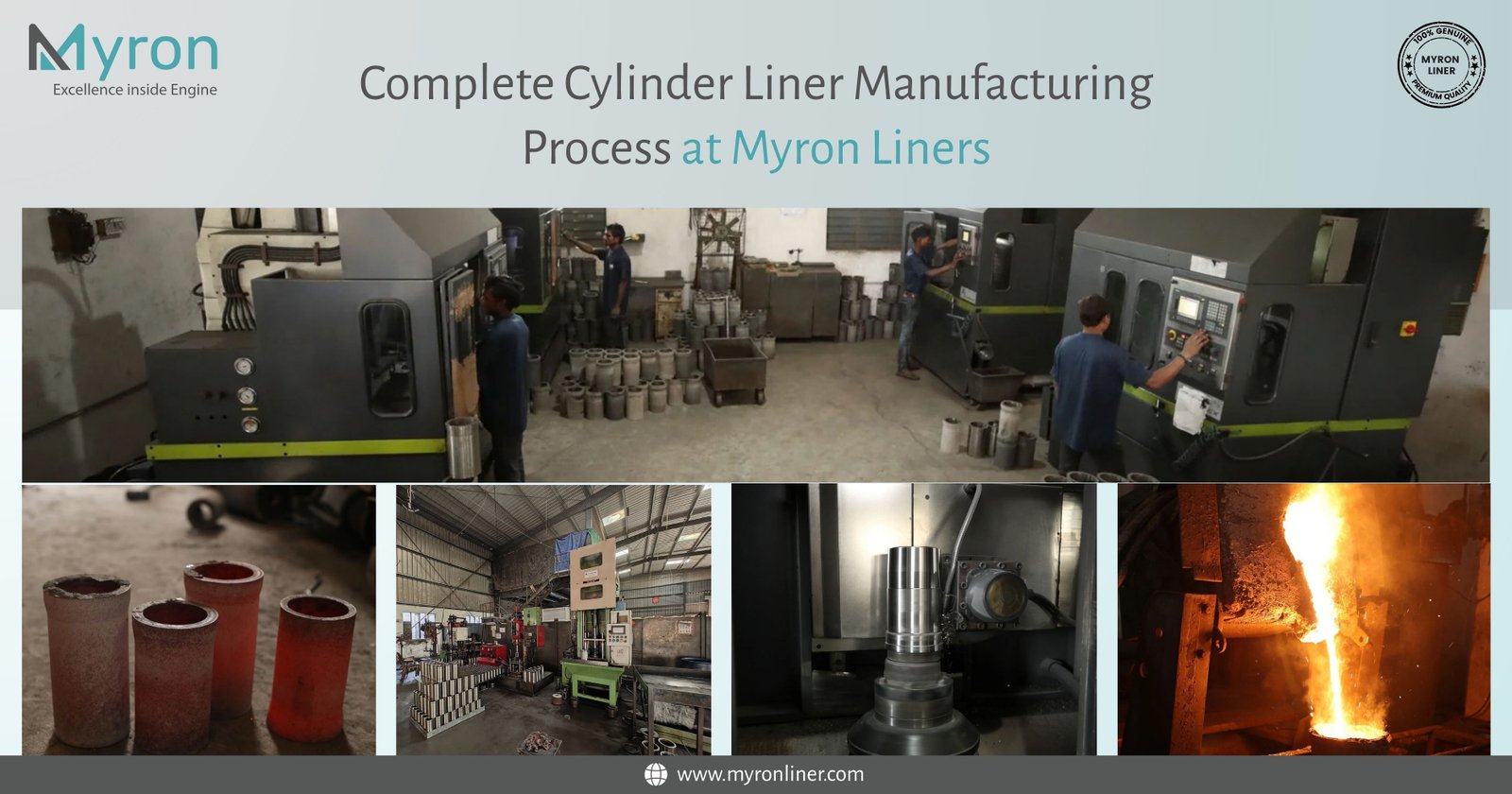
Complete Cylinder Liner Manufacturing Process at Myron Liners
In the world of engine parts, the cylinder liner, or cylinder sleeve, is very important. It is the inner surface where a piston moves back and forth. Its precision, durability, and material quality directly affect engine performance, longevity, and reliability.
For aftermarket engine parts manufacturers, delivering excellence in cylinder liners is non-negotiable. In this article, we explain the entire process of making cylinder liners at Myron Liners. We highlight the key steps, materials, techniques, and quality control practices. These ensure that every liner performs well.
1. Raw Material Selection & Inspection
1.1 Choosing the Right Material
At the start of the process, choosing the right cylinder liner material is of utmost importance. Most commonly, cast iron variants are used for liners due to their wear resistance, thermal conductivity, and compatibility with lubricants. Some liners may be alloyed or treated (e.g. chrome plating or special coatings) to improve surface hardness and reduce friction.
1.2 Incoming Material Inspection
When raw material arrives, Myron Liners carries out rigorous inspection. The team checks the material batch for chemical composition (via spectrometer or chemical analysis), inclusion content, and other metallurgical properties.
Any material not matching specifications is rejected or set aside. This step is critical because defects at this stage will propagate through the later stages. This practice contributes to consistent quality in India manufacturing for engine parts.
2. Melting & Pouring
With the raw material verified, the next step is melting and pouring as part of the casting process.
2.1 Melting
The selected metal is melted in induction or electric furnaces under controlled conditions. Temperature, time, and alloy additions are carefully monitored to maintain consistent melt chemistry.
2.2 Pouring into Mold
Once the metal reaches the correct molten temperature, it is poured into molds. At Myron Liners, they use centrifugal die casting, or rotocasting.
In this process, the mold spins quickly while molten metal is poured in. This causes the metal to distribute uniformly against the inner walls of the spinning mold due to centrifugal force. The process helps in achieving a density gradient with fewer defects, and more uniform structure.
The solidification starts at the outer wall and moves inward. This process helps push impurities to the inner surface, which can be removed later.
3. Centrifugal Casting & Core Removal
In the centrifugal casting phase:
- The mold is spun at a calculated RPM.
- Molten metal is injected or poured.
- The spinning ensures tight adherence of metal to mold walls.
- The center (where impurities concentrate) may later be machined out or cleaned.
After solidification, the workers remove the casting and take out any cores, inserts, or internal supports (if used). The rough casting now approximates the final liner dimensions, though much machining remains.
4. Primary Machining (Rough Turning & Boring)
Once castings are freed from molds, they undergo primary machining:
4.1 Rough Turning & Boring
The casting is first shaped on CNC machines. This process brings the inner diameter (ID) and outer diameter (OD) to approximate tolerances. At this stage, excess metal is removed to bring the part closer to its finished dimensions.
4.2 Facing & Trimming
End faces are trimmed, flange surfaces are made flat, and excess flash is removed. This also helps in preparing the liner for further grinding and honing steps.
5. Secondary Machining & Grinding
After the rough machining, more precision finishing begins:
5.1 Centerless & Cylindrical Grinding
The liner surfaces are ground using centerless grinding machines or cylindrical grinding machines. The goal is to get very tight tolerances on diameter, roundness, and surface finish. This step ensures the liner’s outer surface and inner bore are smooth, consistent, and dimensionally precise.
5.2 Boring & ID Grinding
If needed, the inner diameter is adjusted using special grinding or boring machines. This helps achieve the right size and shape.
6. Honing & Surface Finishing
One of the most critical steps in the manufacturing process is honing. This is how you get the final precise geometry and surface texture that ensures optimal lubrication and wear resistance.
6.1 Honing
Using abrasive stones or diamond tools, the inner bore is honed to final dimension and surface finish. Honing smooths micro-irregularities, gives a crosshatch pattern (for oil retention), and ensures perfect roundness. Myron Liners uses plateau honing and multi-stone honing methods. These techniques help them meet strict standards for dry and wet cylinder liners.
6.2 Final Surface Treatments
Depending on the liner design, surface treatments or coatings (such as phosphate coatings or chrome plating) may be applied. These treatments improve wear resistance, reduce friction, or provide corrosion protection.
7. Quality Control & Inspection
Quality control is the backbone of any robust manufacturing process, especially for engine parts. At Myron Liners, quality is integrated at every stage—“from raw to finished”.
7.1 Dimensional & Geometric Inspection
Parts are measured during and after machining. Tools used for measuring include:
- Coordinate measuring machines (CMM)
- Micrometers
- Bore gauges
- Surface profilometers
- Roundness testers Tolerances for roundness, cylindricity, bore size, taper, and surface finish are strictly checked.
7.2 Material Properties & Hardness
Each liner is tested for hardness to ensure the correct metallurgical properties. Microstructure analysis via microscopes checks for graphite structure, inclusion distribution, and grain morphology. Chemical composition is rechecked in some cases.
7.3 Non-Destructive Testing (NDT)
Methods like ultrasonic testing, magnetic particle inspection, and dye penetrant testing can find cracks or internal defects. These issues are often invisible to the naked eye.
7.4 Surface Quality & Finish
Surface roughness parameters (Ra, Rz, etc.) are measured to confirm they’re within specifications. The crosshatch angle and pattern on the bore is verified (critical for oil retention in the liner).
7.5 Final Visual & Functional Inspection
Before packaging, each liner is visually inspected for cosmetic defects, burrs, tool marks, or any anomalies. Sometimes a “go/no-go” gauge or fit test with mating components is conducted.
Read More: 10 Major Cylinder Liner Defects and How to Prevent Them
8. Cleaning, Marking & Packaging
Once a liner passes all inspections:
- It is ultrasonically cleaned or washed to remove any machining residues, oil, or particles.
- Dried and sometimes coated with protective oil to prevent corrosion during storage or shipping.
- Each liner is laser-etched or engraved with batch numbers, cylinder liner part numbers, logos, and traceability marks.
- Finally, parts are packaged in protective materials, boxed, and prepared for dispatch. Myron Liners maintains a dedicated packing area (~18,000 square feet) equipped for this purpose.
9. Traceability & Batch Control
In India manufacturing and especially when dealing in aftermarket engine parts, traceability is essential. Each batch of cylinder liners has records. These include raw material batches, heat treatment, machine process logs, inspection records, and packaging records. This makes sure that if any problem comes up in the field, we can trace the production history and take action.
10. Supply Chain, Logistics & Delivery
Because Myron Liners operates in the aftermarket segment (not OEM), flexibility and responsiveness in logistics are critical. After packaging, parts are stored in organized areas. These areas are based on size, use, or customer. Parts are sent out based on demand.
India’s well-developed transport and exports infrastructure help in timely delivery both domestically and to export markets. This makes Myron Liners competitive as a supplier of engine parts from India manufacturing.
FAQ
Q1: What is the difference between a cylinder liner and a cylinder sleeve?
A: Cylinder liners are the inner surface where pistons move; sleeves are replaceable liners inserted into the engine block.
Q2: What materials are used for cylinder liners?
A: High-grade cast iron or alloyed cast iron, sometimes coated with chrome or phosphate for wear resistance.
Q3: Which casting method is used for cylinder liners?
A: Mainly centrifugal casting, which ensures uniform density and minimal defects.
Q4: What is the difference between wet and dry liners?
A: Wet liners contact coolant directly for better cooling; dry liners do not touch coolant and rely on the block for cooling.
Q5: What is the centrifugal casting process?
The centrifugal casting process spins a mold while molten metal is poured in, forcing the metal against the mold walls. This creates a dense, uniform cylinder with fewer impurities, ideal for cylinder liners.
Reference & Trademark Disclaimer
All manufacturer names, trademarks, logos, product names, part numbers, model numbers, descriptions, and other identifying references mentioned in this article are used for identification, reference, and cross-reference purposes only.
Such references do not imply any affiliation, association, authorization, sponsorship, approval, or endorsement by the respective manufacturers or trademark owners. All trademarks, brand names, product names, part numbers, and related intellectual property remain the property of their respective owners.
MYRON LINER LLP is an independent manufacturer and supplier of engine components. The use of any third-party name or reference is solely intended to help readers identify the applicable engine, component, or application.