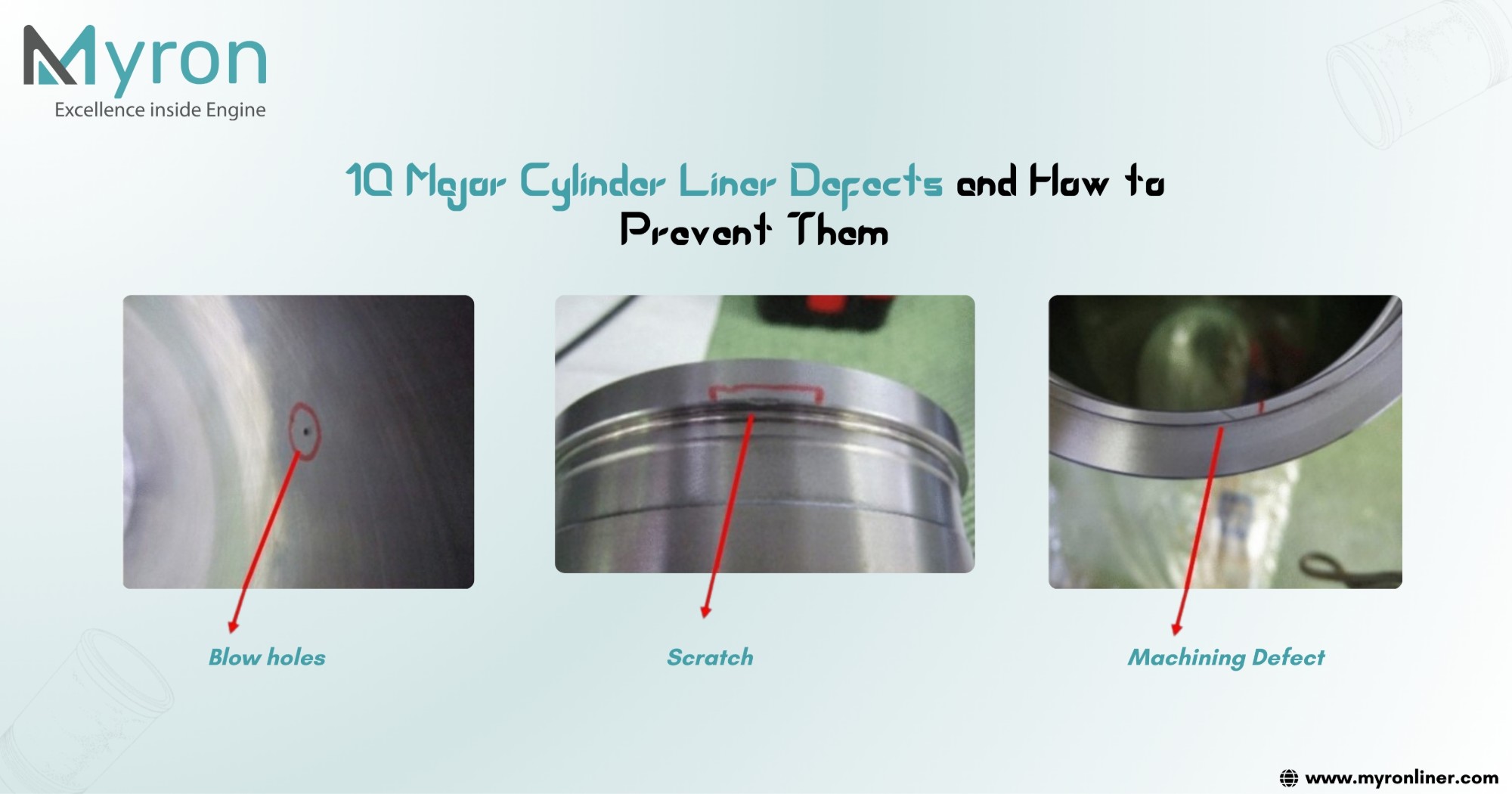
10 Major Cylinder Liner Defects and How to Prevent Them
Cylinder liners, often referred to as engine liners, play a vital role in engine operation. They form the surface within which pistons move, and their durability, strength, and finish directly impact engine performance. Whether it's a dry liner or a wet liner, manufacturers and suppliers must ensure these components are defect-free. Yet, many buyers still report recurring issues that lead to engine failure, reduced efficiency, or expensive maintenance cycles.
This blog explores the 10 most common cylinder liner defects reported by buyers and provides practical ways to prevent them. If you're in the manufacturing or automotive component supply chain, understanding these defects and addressing them proactively is key to achieving long-term customer satisfaction and zero complaint performance.
1. Inconsistent or Out-of-Tolerance Bore ID
Issue: The internal diameter of the cylinder liner is too large or too small, resulting in an improper fit for pistons.
Consequences: This leads to issues like piston ring wear, poor compression, excessive blow-by, or engine knocking. Even a slight taper or variation along the bore length can compromise performance.
Prevention Tips:
- Use advanced CNC machining for consistent boring.
- Maintain tight control of tolerances (<0.01–0.03 mm).
- Perform in-process inspection using calibrated bore gauges.
Manufacturers must also monitor the thermal expansion properties of their liner material since excessive bore distortion can occur once the engine heats up, affecting the cylinder liner's efficiency over time. This is especially critical in turbocharged or high-compression engines.
2. Ovality (Out-of-Round Cylinder Bore)
Issue: The bore of the engine liner is not perfectly circular.
Consequences: This causes uneven piston ring contact, reduced sealing, and results in oil consumption, poor combustion, and accelerated wear.
Prevention Tips:
- Measure roundness using precision metrology equipment.
- Ensure uniform cooling during casting to avoid deformation
- Regular machine maintenance to prevent tool wear.
Furthermore, repeated cycles of heating and cooling can increase the ovality effect over time, especially in poorly alloyed liners. Engineers should analyze the long-term behavior of liners using simulated stress testing.
3. Surface Finish Irregularities
Issue: The liner surface is either too rough or too smooth, which can affect lubrication and piston movement.
Consequences: A rough surface may lead to scuffing, while an overly smooth surface causes poor oil retention and glazing. Both reduce engine efficiency.
Prevention Tips:
- Maintain surface roughness average (Ra) within 0.2–0.4 microns.
- Apply precise cross-hatch honing (ideal angle: 45°).
- Conduct surface profilometer testing for quality control.
Over-polishing may result in mirror finishes that don't retain lubricating oil, causing dry contact between piston rings and liner walls. This is more common in dry liners, where the lubrication window is narrow.
4. Uneven Wall Thickness
Issue: Liner walls are not uniformly thick, especially in dry liners and wet liners.
Consequences: Uneven thickness may cause localized heating, structural weakness, distortion, or cracking under stress.
Prevention Tips:
- Use ultrasonic wall thickness gauges.
- Improve centrifugal casting quality.
- Perform random cross-sectional destructive testing.
Wall thickness also affects heat dissipation. In wet liners, if one side is thinner, it may expand faster than the rest and cause internal coolant leaks or cylinder block warping.
Read More: A Complete Guide to the Different Types of Cylinder Liners
5. Cracking or Fractures
Issue: Hairline cracks or visible fractures often appear after installation or during stress testing.
Consequences: This leads to catastrophic engine failure, coolant or oil leaks, and possible engine seizure.
Prevention Tips:
- Control cooling rate post-casting.
- Perform dye penetrant testing and pressure testing.
- Eliminate internal stresses during heat treatment.
Cracks are commonly caused by improper quenching, residual stress, or contamination in the casting alloy. Detailed metallurgical inspections are essential to avoid this.
6. Poor Material Composition
Issue: Engine liners made from low-grade iron or with improper alloy mixtures lack the necessary strength and wear resistance.
Consequences: Excessive wear, liner deformation, and premature failure.
Prevention Tips:
- Use high-grade cast iron or iron alloy compositions.
- Confirm material hardness (typically 200–280 BHN for most applications).
- Conduct microstructure analysis and spectrochemical testing.
A consistent alloy mix ensures better fatigue strength. In dry liners, hardness uniformity is critical due to the lack of coolant contact that aids in heat distribution.
7. Corrosion or Rusting
Issue: Liners arrive with surface rust or degraded protective coating, especially in humid storage environments.
Consequences: Difficulty in installation, increased friction, and eventual failure of the liner and rings.
Prevention Tips:
- Apply rust-preventive coatings.
- Use VCI (Volatile Corrosion Inhibitor) packaging.
- Store in controlled environments and inspect packaging before dispatch.
Additionally, transportation over long distances—especially by sea—exposes liners to condensation risk. Vacuum sealing with desiccant packs can significantly extend shelf life.
8. Dimensional Inaccuracy
Issue: Overall liner dimensions (length, OD, step OD) are incorrect or do not match specifications.
Consequences: Misfitting liners can lead to vibration, coolant leaks in wet liners, or block misalignment.
Prevention Tips:
- Carry out dimensional audits before shipment.
- Reconfirm specifications for different engine models.
- Ensure tooling and fixtures are verified for consistency.
For wet liners, improper dimensions can prevent proper sealing with O-rings, leading to leaks. For dry liners, improper OD could cause press-fit failure or liner movement during operation.
9. Porosity or Blow Holes
Issue: Small air pockets or porosity in the liner structure due to casting defects.
Consequences: Coolant or oil leakage through liner walls, reduced durability, or structural failure.
Prevention Tips:
- Perform non-destructive testing like ultrasonic or radiographic inspection.
- Improve mold design and casting practices.
- Degas molten metal thoroughly before casting.
Using vacuum casting or low-pressure casting reduces the occurrence of internal cavities. Ensuring foundry cleanliness is also essential.
10. Incomplete Chamfering or Deburring
Issue: Sharp or unfinished liner edges can interfere with piston installation.
Consequences: Ring snagging, liner damage, or ring seizure during engine operation.
Prevention Tips:
- Chamfer edges during final machining.
- Use automated deburring and edge-finishing tools.
- Perform 100% inspection of critical edges.
A properly chamfered liner also improves oil flow at ring entry points, minimizing startup wear. This is especially relevant in high-performance diesel engines.
Read more: High-Performance Alloys for Aftermarket Pistons: A Complete Guide.
Proactive Quality Control: Preventing Buyer Complaints
Preventing these cylinder liner defects starts with a well-structured quality assurance plan. Here are the essential quality control steps:
Quality Control Checklist:
Dimensional Testing:
Key dimensions like bore ID (inner diameter), OD (outer diameter), length, taper, and ovality must be checked using precision tools like coordinate measuring machines (CMM), dial gauges, or air gauges. Any deviation beyond tolerance can cause improper piston fitment or operational failure. Special attention should be given to measuring taper at different heights and checking for uniformity along the liner's length to ensure optimal piston movement and sealing.
Hardness Testing:
Hardness testing is conducted to verify that the liner material meets the required Brinell Hardness Number (BHN), typically ranging from 200 to 280 BHN for cast iron liners. Consistency across multiple points—top, middle, and bottom—is crucial to prevent premature wear and ensure even load distribution during engine operation. If hardness is not uniform, it could indicate improper heat treatment or material inconsistencies that can shorten engine life.
Surface Finish Inspection:
Surface finish plays a critical role in oil retention, piston ring seating, and wear resistance. Using a profilometer, Ra (roughness average) should be verified along with visual cross-hatch pattern inspection—ideally 40–60° for oil film retention. A rough surface may lead to high friction and wear, while an overly smooth one may result in oil glazing and ring slippage. This balance is essential for the engine's break-in and long-term performance.
Material Testing:
Metallurgical analysis ensures that the microstructure of the liner material has the correct phase composition (pearlite/ferrite) and grain structure, offering the required durability and heat resistance. Chemical composition is also verified through spectrometry or wet chemical analysis to detect impurities and ensure alloying consistency. Failure in this step may result in liners that are too soft, brittle, or prone to thermal distortion under operating loads.
Crack Detection:
Hairline or microscopic cracks can form during casting or due to improper cooling and handling. Dye penetrant tests, pressure testing (for wet liners), and detailed visual inspection under good lighting help identify any internal or external cracks. Cracks, if undetected, can lead to sudden failure during installation or operation, posing a serious threat to the entire engine assembly.
Porosity Testing:
Porosity or blow holes—caused by trapped gases during casting—can compromise the liner's structural integrity. Ultrasonic or radiographic (X-ray) testing is used to detect such hidden internal defects. These flaws often become evident only after the liner is installed, leading to coolant or oil leakage, which not only affects engine performance but also leads to warranty claims and loss of customer trust.
Packaging & Preservation:
After manufacturing, liners should be adequately cleaned, coated with anti-corrosive oils, and packed in moisture-resistant packaging. Using VCI (Volatile Corrosion Inhibitor) papers, rust-preventive bags, and secure wooden or cardboard crates ensures that liners arrive in pristine condition. Poor packaging may result in rusting, surface damage, or contamination—all of which are common reasons for rejection upon delivery.
When each of these steps is followed consistently, it reduces the risk of product rejections, return shipments, or warranty claims. Strong quality documentation also helps aftermarket suppliers and rebuilders trace root causes during engine failure analysis, ensuring faster resolutions and better service.
Read more: Understanding How Engine Piston Rings Work.
Final Thoughts
Cylinder liners, whether dry or wet, are the foundation of reliable engine performance. Even minor manufacturing errors or oversights can lead to serious engine cylinder failures—costing customers time, money, and trust. By proactively identifying and preventing these defects, aftermarket suppliers can ensure better product reliability and reduce customer complaints.
In the aftermarket engine parts industry, consistent quality is key to maintaining customer loyalty. A defect-free cylinder liner not only enhances engine performance but also builds long-term trust with mechanics, rebuilders, and fleet operators who depend on reliable replacements.
About Myron Liners
Myron Liners is a leading manufacturer and supplier of high-quality cylinder liners trusted by OEMs and engine rebuilders worldwide. Specializing in both dry liners and wet liners, Myron Liners adheres to the highest standards of quality control to ensure every product performs with consistency and durability.
If you're looking for reliable, defect-free engine parts that meet stringent quality requirements, Myron Liners is your go-to source.
FAQ
Q1. What causes cylinder liner defects in engines?
Cylinder liner defects often arise due to poor casting, machining errors, improper heat treatment, or inadequate quality control. Common issues include taper, ovality, cracks, and porosity, which can severely impact engine performance and longevity.
Q2. How can I prevent defects in dry liners and wet liners?
To prevent defects in both dry and wet liners, manufacturers must implement stringent dimensional checks, surface finish inspections, hardness tests, and crack detection methods.
Q3. Why is surface finish important in a cylinder liner?
The surface finish impacts oil retention, ring seating, and overall lubrication. Improper finish can lead to scuffing, blow-by, and excessive wear. Ideal surface roughness (Ra) and correct cross-hatch angles (typically 40–60°) ensure proper engine liner function.
Q4. What is the difference between dry liners and wet liners?
A dry liner fits snugly into the cylinder without direct contact with coolant, while a wet liner comes in direct contact with engine coolant, aiding in better heat dissipation. Wet liners typically require better sealing and are more vulnerable to leakage if not correctly installed.
Reference & Trademark Disclaimer
All manufacturer names, trademarks, logos, product names, part numbers, model numbers, descriptions, and other identifying references mentioned in this article are used for identification, reference, and cross-reference purposes only.
Such references do not imply any affiliation, association, authorization, sponsorship, approval, or endorsement by the respective manufacturers or trademark owners. All trademarks, brand names, product names, part numbers, and related intellectual property remain the property of their respective owners.
MYRON LINER LLP is an independent manufacturer and supplier of engine components. The use of any third-party name or reference is solely intended to help readers identify the applicable engine, component, or application.