Why Centrifugal Casting Is Better Than Sand Casting for Cylinder Liners and Sleeves
Manufacturing durable and high-performance engine parts requires precision, consistency, and the right production method. The Cylinder Liner and cylinder sleeve are very important engine parts. They deal with high temperature, pressure, and friction inside the engine.
Because of these demanding conditions, choosing the right casting process to manufacture these parts becomes extremely important. Two widely used methods are Centrifugal Casting and the Sand Casting process, but they produce very different results. Over the years, manufacturers and engineers across the world have moved toward Centrifugal Casting because of its superior quality, durability, and performance benefits.
In this blog, we will look at why Centrifugal Casting is better than Sand Casting for Cylinder Liners and Sleeves. We will explain how each process works, what makes them different, and why this is important for engine life and performance.
Understanding the Role of Cylinder Liners and Sleeves in an Engine
Before comparing casting methods, it is important to understand the role of the cylinder liner in an engine.
These components:
- Form the sliding surface for the pistons
- Maintain optimal compression inside the combustion chamber
- Withstand extremely high temperatures
- Resist abrasion and heavy friction
- Help maintain lubrication inside the engine
- Improve heat transfer
Because of these responsibilities, the liner must be dense, strong, crack-resistant, heat-resistant, and dimensionally accurate. The manufacturing quality directly affects engine performance and lifespan. That’s why the casting method makes such a big difference.
What Is Sand Casting?
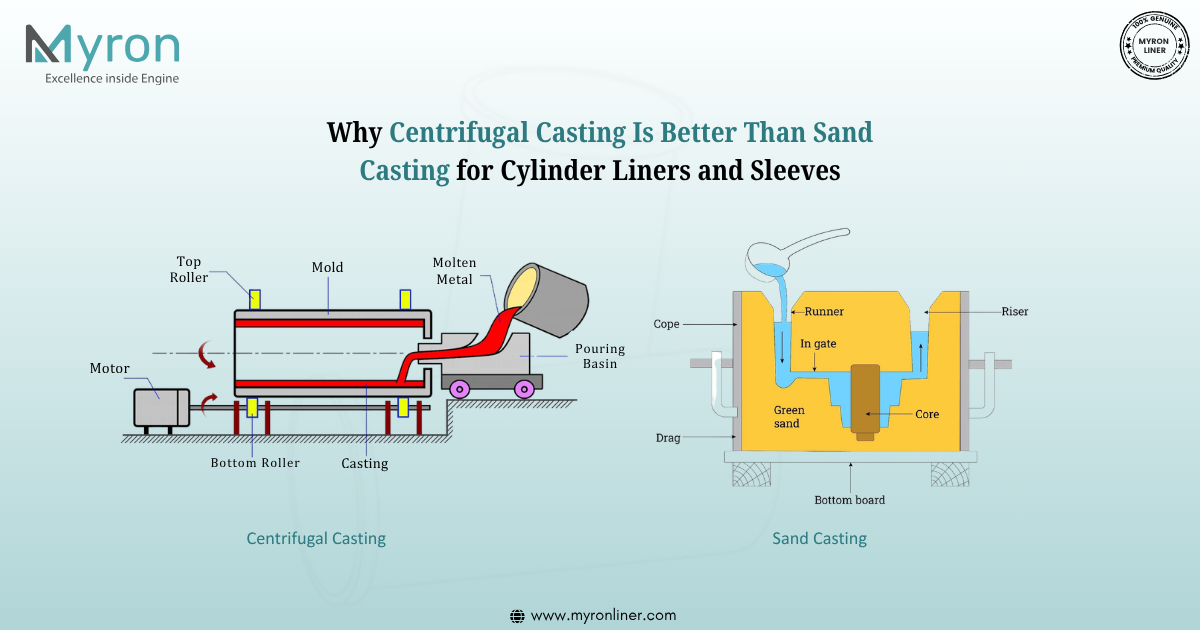
The Sand Casting process is one of the oldest methods of metal casting. Here’s how it generally works:
- A pattern of the part is created.
- Sand mixed with binders is packed around the pattern to form a mold.
- Molten metal is poured into the hollow space.
- Once cooled, the mold is broken to remove the part.
Sand casting is easy and affordable. However, it has some drawbacks for making high-precision engine parts like liners and sleeves.
Limitations of Sand Casting
- Higher chances of porosity (tiny air pockets inside the metal)
- Lower mechanical strength
- Less uniform grain structure
- Rough surface finish
- More machining required
- Higher probability of casting defects
- Lower density
These problems can lower engine efficiency, increase wear, and even cause failure in stressed parts like cylinder liners.
What Is Centrifugal Casting?
Centrifugal Casting is a more advanced and specialized casting process. Unlike Sand Casting, it uses rotational force to distribute molten metal inside a mold.
The process typically works like this:
- A cylindrical mold is rotated at high speed.
- Molten metal is poured into the spinning mold.
- Centrifugal force pushes the metal uniformly outward.
- Impurities are forced toward the inside surface and later machined away.
- The outer structure becomes extremely dense and defect-free.
This technology creates stronger, cleaner, and more uniform metal structures. This makes it perfect for cylinder liners and sleeves.
Why Centrifugal Casting Is Superior: A Detailed Comparison
Let’s break down the advantages one by one.
Higher Density and Strength
The spinning action in Centrifugal Casting pushes molten metal outward with great force. This removes air bubbles and impurities, resulting in:
- A very dense microstructure
- Better mechanical strength
- Higher load-bearing capacity
Sand Casting cannot match this density because it relies only on gravity.
Impact on Liners:
A denser liner means reduced wear, better combustion sealing, and a longer engine life.
Fewer Defects and Better Structural Integrity
Centrifugal Casting naturally eliminates:
- Shrinkage defects
- Gas porosity
- Loose grain structure
- Internal cavities
All impurities get pushed inward and are removed during machining.
In Sand Casting, defects like porosity and shrinkage are common, reducing reliability.
Superior Grain Structure
The rapid cooling at the outer surface during Centrifugal Casting creates:
- Fine, uniform grain structure
- Better strength
- Higher resistance to cracking
A Cylinder Liner made this way is more stable under high temperatures and pressure.
Better Mechanical Properties
Centrifugal Casting improves:
- Tensile strength
- Hardness
- Fatigue resistance
- Wear resistance
For an engine’s harsh environment, these qualities are essential.
Sand-cast parts often require extra machining or heat treatment to reach similar levels—and still fall short.
Cleaner and Smoother Internal Surfaces
Because molten metal distributes evenly, the inner surface becomes smoother and more consistent.
This helps with:
- Reduced friction between piston and liner
- Better lubrication retention
- Lower fuel consumption
- Reduced engine noise
Sand-cast liners, on the other hand, often require extensive finishing to achieve acceptable smoothness.
Better Dimensional Accuracy
Centrifugal Casting uses steel or metal molds, which hold their shape much better than sand molds. This leads to:
- Improved dimensional accuracy
- Consistent thickness
- Minimal deformation during cooling
Sand Casting can produce uneven wall thickness or warping due to mold instability.
Higher Production Efficiency
Although Centrifugal Casting requires more advanced equipment, the overall production process is efficient:
- Faster cooling
- Shorter production cycles
- Less machining required
- Fewer rejected parts
For manufacturers, this means lower long-term costs and consistent quality.
Longer Life of Cylinder Liners
Because of the density, uniformity, and mechanical strength, centrifugal-cast Cylinder Liners and sleeves last significantly longer.
They offer:
- Superior wear resistance
- Better heat transfer
- Higher pressure stability
- Long-term performance without distortion
This is especially important for heavy-duty engines and high-performance machinery.
Why Do Engine Manufacturers Prefer Centrifugal Casting?
From automotive manufacturers to industrial engine makers, most large companies now prefer centrifugal-cast liners because:
- They deliver consistent quality
- They reduce warranty issues
- They improve overall engine performance
- They reduce failure rates
- They support modern high-performance engines
As engines get stronger and use less fuel, the need for reliable Cylinder Liners has increased. Centrifugal Casting meets these needs perfectly.
When Sand Casting Is Still Used
Despite its shortcomings, Sand Casting is still suitable for:
- Large, simple parts
- Lower-cost components
- Less stressed engine parts
- Prototyping
However, for critical engine components like cylinder sleeves and liners, Centrifugal Casting remains the preferred option.
Final Thoughts
When it comes to essential engine parts like Cylinder Liners and cylinder sleeves, quality cannot be compromised. After comparing both casting methods, it is clear that Centrifugal Casting consistently outperforms the Sand Casting process in:
- Strength
- Density
- Precision
- Durability
- Heat and wear resistance
- Overall engine performance
Engines today operate at higher pressures and temperatures, so choosing the right casting process is more important than ever. Centrifugal Casting ensures the parts are reliable, long-lasting, and capable of supporting modern engine demands.
About Myron Liners: Trusted Manufacturer and Supplier of Cylinder Liners
For customers looking for high-quality, precision-engineered cylinder liner products,
Myron Liners is one of the leading manufacturers and suppliers in the industry.
They specialize in producing durable, high-performance liners using advanced Centrifugal Casting technology to ensure excellent strength, density, and reliability.
Whether you need liners for automotive, industrial, or heavy-duty engines, Myron Liners ensures consistent quality and performance.
Reference:
Centrifugal casting (industrial) by Wikipedia[1].
Sand casting by Wikipedia[2].
FAQ
1. What is the main difference between Centrifugal Casting and Sand Casting?
- Centrifugal Casting uses high-speed rotation to push molten metal outward, producing a dense, defect-free structure.
- Sand casting uses gravity to fill a sand mold. This can cause porosity, lower density, and uneven grain structure.
2. Why is Centrifugal Casting better for Cylinder Liners?
Centrifugal Casting offers:
- Higher density
- Fewer defects
- Superior mechanical strength
- Better surface finish
- Greater durability under high temperature and pressure
These advantages are essential for Cylinder Liners, which must withstand extreme friction and heat inside the engine.
3. Is Sand Casting still used for engine parts?
Yes, but mostly for large, simple, or low-stress components.
For critical engine components like Cylinder Liners and cylinder sleeves, manufacturers prefer Centrifugal Casting because it provides stronger and more reliable results.
4. Are Centrifugal-Cast Cylinder Liners more expensive?
The upfront cost is slightly higher due to the specialized machinery and molds.
They last much longer, reduce wear, and improve engine performance. This makes them more cost-effective over time.
5. What are the major problems with Sand Casting for Cylinder Liners?
Common issues include:
- Porosity (air pockets)
- Uneven cooling
- Lower strength
- Shrinkage defects
- Rough surface finish
- Low dimensional accuracy
These problems can reduce engine efficiency and cause premature failure.
6. Can Sand Casting achieve the same strength as Centrifugal Casting?
Not naturally.
Even with heat treatments and machining, Sand Casting struggles to match the:
- Density
- Uniformity
- Grain structure
- Strength properties
- of Centrifugal Casting.
7. Which engines commonly use Centrifugal-Cast liners?
Centrifugal-cast liners are used in:
- Cars
- Motorcycles
- Commercial trucks
- Tractors
- Diesel engines
- Industrial engines
- Marine engines
- Power generators
Almost all modern engines rely on centrifugal-cast liners for performance and longevity.
8. Does Centrifugal Casting improve fuel efficiency?
Yes, indirectly.
A stronger, smoother, and more accurate liner improves:
- Piston movement
- Heat dissipation
- Lubrication
- Compression retention
These factors help the engine run more efficiently, which can reduce fuel usage.
9. Which casting process provides better heat resistance?
Centrifugal Casting, because it produces a dense metallurgical structure with fewer impurities, allowing the liner to withstand higher temperatures without warping or cracking.
10. Why do manufacturers prefer Centrifugal Casting for high-performance engines?
Because high-performance engines require:
- High RPM stability
- Excellent heat resistance
- Strong wear resistance
- Dimensional accuracy
- Long service life
Centrifugal Casting delivers all these advantages, while Sand Casting cannot meet the same standards.
Reference & Trademark Disclaimer
All manufacturer names, trademarks, logos, product names, part numbers, model numbers, descriptions, and other identifying references mentioned in this article are used for identification, reference, and cross-reference purposes only.
Such references do not imply any affiliation, association, authorization, sponsorship, approval, or endorsement by the respective manufacturers or trademark owners. All trademarks, brand names, product names, part numbers, and related intellectual property remain the property of their respective owners.
MYRON LINER LLP is an independent manufacturer and supplier of engine components. The use of any third-party name or reference is solely intended to help readers identify the applicable engine, component, or application.
Reference & Trademark Disclaimer
All manufacturer names, trademarks, logos, product names, part numbers, model numbers, descriptions, and other identifying references mentioned in this article are used for identification, reference, and cross-reference purposes only.
Such references do not imply any affiliation, association, authorization, sponsorship, approval, or endorsement by the respective manufacturers or trademark owners. All trademarks, brand names, product names, part numbers, and related intellectual property remain the property of their respective owners.
MYRON LINER LLP is an independent manufacturer and supplier of engine components. The use of any third-party name or reference is solely intended to help readers identify the applicable engine, component, or application.